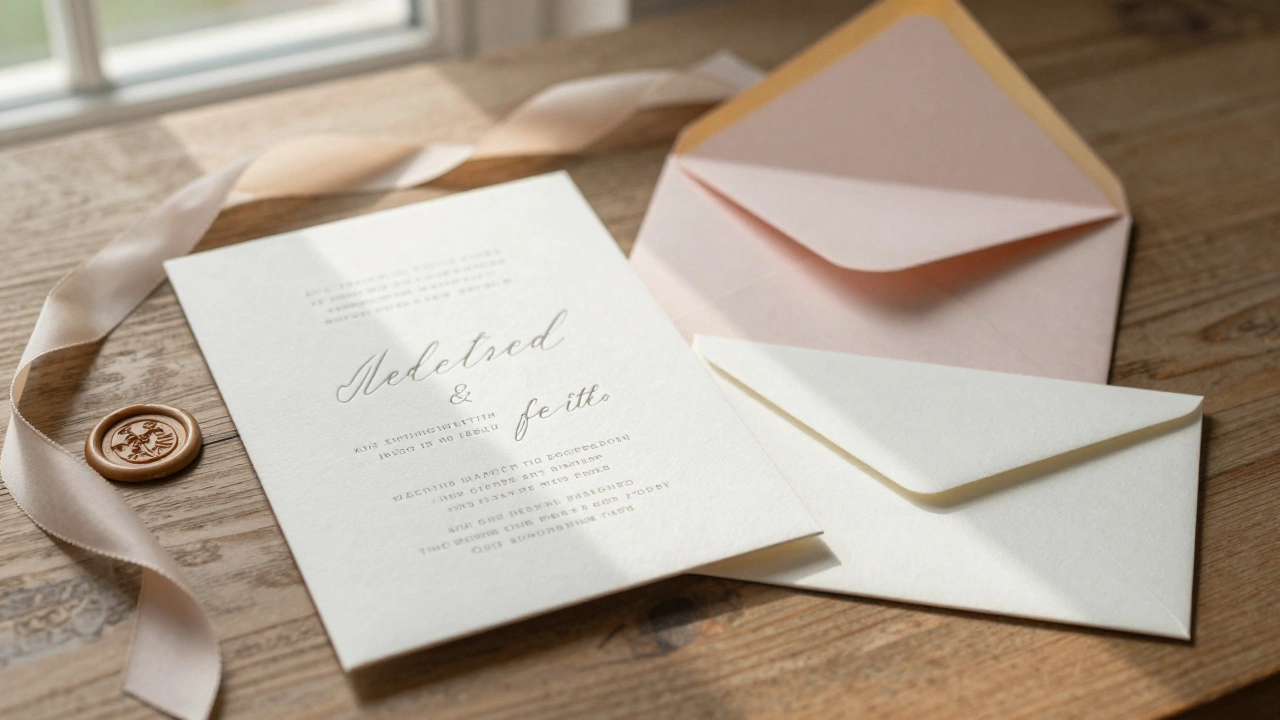
Wedding Invitation Budget Calculator
Calculate Your Invitation Costs
Estimate costs for 100-150 guests based on industry averages
Your Estimated Cost
Tips for saving money:
- Use digital RSVPs to save $0.25-$0.50 per invite
- Choose standard postage size to avoid extra fees
- Skip envelope lining (saves $0.75-$1.50 per invite)
- Print locally for better pricing
Most couples don’t realize how much wedding invitations can add to their budget until they’re staring at a quote for 150 custom-printed cards with foil lettering and envelope lining. The truth? You can spend anywhere from $50 to over $1,500 on invitations - and the average person spends about $400. That’s not a typo. For a typical guest list of 100 to 150 people, most couples end up paying between $3 and $5 per invite, including printing, envelopes, postage, and extras like RSVP cards and envelope addressing.
What’s actually included in that $400?
It’s easy to think of wedding invitations as just a piece of paper. But what you’re really paying for is the whole package: design, materials, printing method, assembly, and delivery. A basic digital print on standard cardstock might cost $1.25 per invite. Add in thick cotton paper, letterpress printing, and custom envelope liners, and that same invite jumps to $7 or more. Then there’s postage. A standard invite weighs about 1 ounce and costs $0.73 to mail. But if you add a reply card, a wax seal, or a ribbon, you’re now in the 2-ounce range - which bumps the cost to $1.08 per piece. For 120 invites, that’s over $130 just in stamps.
Envelope addressing is another hidden cost. Handwriting every name? That’s time-consuming. Hiring a calligrapher runs $1 to $3 per envelope. Even digital printing of addresses adds $0.25 to $0.50 per envelope. For 120 invites, that’s $30 to $360 extra. Most couples skip the calligraphy and go with printed addresses, but it’s still a line item that adds up.
How your guest list changes the math
The size of your guest list is the biggest factor in your invitation budget. A small wedding with 50 guests might only need $150 to $250 in invitations. But if you’re inviting 200 people, you’re already looking at $600 to $1,000, even on a tight budget. Many couples don’t realize that the cost doesn’t scale linearly - it spikes when you add extras.
For example: a couple invites 180 guests and wants to include:
- 3-piece suite (invite, reply card, envelope)
- Letterpress printing on 100% cotton paper
- Envelope lining in a custom color
- Hand-addressed envelopes
- Postage for 2-ounce pieces
That setup can easily hit $8 per invite. Multiply that by 180, and you’re at $1,440 - more than half the cost of some people’s entire wedding cakes. That’s why many couples start with a realistic guest list and stick to it. If you’re trying to cut costs, trimming your list by 20 people can save you $160 or more.
Where you can cut without looking cheap
You don’t need to go with the cheapest option to save money. Smart choices make a big difference.
- Skip the envelope lining. It’s beautiful, but it adds $0.75 to $1.50 per invite. Most guests won’t notice it’s missing.
- Use digital RSVPs. Instead of a reply card, include a website link. That saves $0.25 to $0.50 per invite and cuts down on lost cards.
- Choose standard postage size. Oversized invites cost more to mail. Stick to 5x7 or 4.25x6.25 inches to avoid extra postage.
- Print locally. Online vendors like Minted or Zazzle are convenient, but local print shops often charge less for the same quality. Ask about bulk discounts.
- Do your own addressing. If you have time, write addresses yourself. It’s personal, and it saves $100+.
One couple saved $220 by switching from letterpress to digital printing, dropping their per-invite cost from $6.50 to $3.25. They kept the same design, same paper, and just changed the printing method. Their guests didn’t notice the difference - and they had $220 left for their honeymoon.

What’s trending in 2026
Design trends are shifting. Couples are moving away from ultra-formal, traditional invitations. Instead, they’re choosing:
- Minimalist designs - clean fonts, single-color palettes, no embellishments.
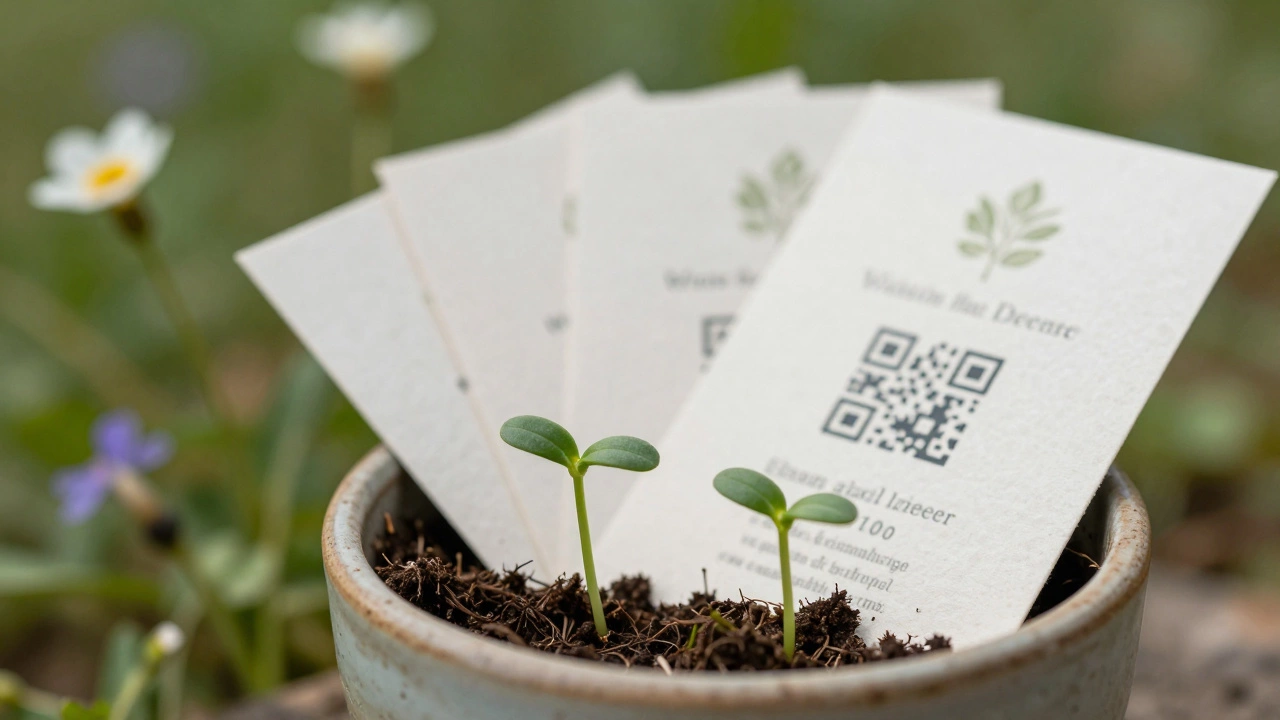
- Recycled or plantable paper - eco-friendly options that cost about the same as standard paper.
- QR codes - linking to wedding websites, maps, or gift registries instead of separate cards.
- Digital invites - still rare for formal weddings, but growing among younger couples. About 12% of couples under 30 now use digital invites only.
Plantable seed paper invites are becoming popular. They cost $3.50 to $4.50 each - slightly more than standard, but they double as a keepsake. Guests plant them after the wedding, and wildflowers grow. It’s a trend that’s sticking because it feels meaningful, not just fancy.
What most couples regret spending on
After the wedding, the most common regret isn’t about the cake or the band - it’s about invitations. Here’s what people wish they’d skipped:
- Wax seals. They look elegant in photos, but they’re fragile, expensive ($0.50 each), and often break in the mail.
- Multiple insert cards. You don’t need a separate card for directions, accommodations, dress code, and registry. Combine them.
- Gold foil on everything. It’s eye-catching, but it adds $1 to $2 per invite and fades over time.
- Custom illustrations of the couple. These can cost $200 to $500 extra and rarely get used after the wedding.
One bride spent $800 on invitations with custom watercolor portraits of her and her fiancé. She later realized no one kept them. The invitations were beautiful, but the money could’ve gone toward a live band or a photo album.
How to budget wisely
Here’s a simple formula to plan your invitation budget:
- Decide your guest count.
- Choose your invite style (basic, mid-tier, luxury).
- Estimate cost per invite: $1.50 (basic), $3.50 (mid), $7+ (luxury).
- Multiply by guest count.
- Add $1.00 per invite for postage (average for 2-ounce pieces).
- Add $0.50 per invite for addressing (if not doing it yourself).
- Subtract any digital savings (no reply cards, no printed directions).
Example: 120 guests, mid-tier invites:
- 120 x $3.50 = $420
- 120 x $1.00 postage = $120
- 120 x $0.50 addressing = $60
- Total = $600
If you skip addressing and use digital RSVPs? Drop to $540. Still a chunk of change - but now you know exactly where it’s going.
Final tip: Order early, but not too early
Order your invitations at least 4 months before the wedding. Most printers need 3 to 6 weeks to produce them. Ordering too early means you might still be adjusting your guest list - and you don’t want to pay to reprint 50 invites because you cut a few names. Ordering too late? You risk missing your deadline. The sweet spot is 16 to 18 weeks out.
And always order 10 to 15 extra invites. Things happen. A guest loses theirs. A family member wants one. A printer makes a mistake. Better to have a few extra than to scramble at the last minute.
Is it cheaper to print wedding invitations at home?
It’s rarely cheaper. Home printers use expensive ink and specialty paper, and the quality often looks amateur. You also need time for cutting, folding, and addressing. Most couples who try it end up spending more in time and frustration than they save in dollars. Unless you have a professional-grade printer and a lot of free time, stick with a print shop.
Do digital wedding invitations save money?
Yes - dramatically. Digital invites cost between $0 and $50 total, depending on the platform. You avoid printing, postage, and addressing costs entirely. But many older guests still expect paper. A good compromise? Send digital invites to younger guests and paper ones to older family members. About 1 in 5 couples now use a hybrid approach.
Why are wedding invitations so expensive?
They’re not expensive because they’re made of paper - they’re expensive because of the labor, design time, and materials. Custom artwork, hand-printing, and premium paper all add cost. Plus, the wedding industry treats invitations as a luxury item, not a necessity. That drives up prices. You’re paying for craftsmanship, not just ink.
Should I include a separate RSVP card?
You don’t have to. Many couples now use online RSVP systems linked via QR code on the invite. This cuts costs, reduces errors, and makes tracking responses easier. If you do use a physical card, make sure it’s pre-addressed with a stamp - people are more likely to return it if it’s already paid for.
What’s the most common mistake people make with wedding invitations?
Waiting too long to order. Most people think they have months to decide, but custom invitations take 6 to 8 weeks to print. If you wait until 8 weeks before the wedding, you’ll pay rush fees - often $100 to $300 extra - just to get them on time.