
Engagement Ring Budget Calculator
Is the old "3 Months Salary" rule still relevant? Find out what makes sense for your wallet in 2026.
Your Financial Details
Budget Analysis
Enter your income to see the comparison.
You are standing in a jeweler's window, staring at a sparkling stone that costs more than your monthly rent. Then you hear it: the old adage that you should spend three months' salary on an engagement ring is a traditional guideline suggesting the groom spends two to three months of his income on the proposal gift. But does this rule actually make sense in today's economy? Spoiler alert: mostly no.
This "rule" wasn't born from ancient tradition or biblical law. It was a marketing campaign by De Beers in the 1930s and 1940s. They wanted to boost diamond sales during the Great Depression and post-war boom. Two months became three because it sounded like a rounder, more impressive number. Today, with housing crises, student loans, and inflation hitting hard in places like Dublin, following this rigid rule can put a serious dent in your savings. So, what should you actually spend? Let's break down the reality behind the myth.
The Origin Story You Didn't Ask For
Before we talk budgets, let's look at where this idea came from. In the 1930s, diamonds were not the default choice for engagement gifts. Gold bands, pearls, and colored gemstones were common. The De Beers company held a monopoly on diamond supply and needed to create demand. They launched the slogan "A Diamond is Forever" in 1947. This wasn't just about love; it was about resale value-or lack thereof. By making diamonds seem permanent and essential, they locked buyers into a high-cost purchase.
The specific "three months' salary" suggestion appeared in later advertising copy. It gave men a concrete target when they had no idea how much to spend. It worked so well that it stuck as cultural folklore. But culture changes. Financial realities change too. Relying on a 1940s marketing tactic to dictate your 2026 finances is risky business.
Why the Three-Month Rule Fails Modern Couples
Let's do some quick math. If you earn €50,000 a year, three months' salary is €12,500. That is a lot of money. For many couples, especially those under 35, saving €12,500 takes years. Meanwhile, the average cost of an engagement ring in Ireland hovers between €3,000 and €5,000. See the gap?
Here is why the rule fails:
- Income Volatility: Gig work, freelance contracts, and variable hours mean "salary" isn't always a fixed number. Calculating three months based on one good month can be misleading.
- Housing Costs: In cities like Dublin, Cork, or Galway, depositing for a home often takes priority over jewelry. Spending €10k on a rock might delay moving in together by six months.
- Resale Value: Diamonds lose 30-50% of their retail value once you walk out of the store. Unlike gold, which holds its melt value, a diamond is a depreciating asset unless it is exceptionally rare.
- Lifestyle Priorities: Some couples prefer a modest ring and a bigger honeymoon fund. Others want a large stone but will skip the fancy venue. There is no universal right answer.
Does spending less mean you care less? Absolutely not. It means you are financially literate. Many couples now view the engagement period as a time to build shared assets, not just display wealth.

A Realistic Budget Framework for 2026
If the three-month rule is out, what replaces it? Experts generally suggest looking at your disposable income rather than gross salary. A better heuristic is to spend what feels comfortable without going into debt. Here is a practical framework to help you decide.
| Annual Gross Income (EUR) | Traditional 3-Month Target | Realistic Market Average | Recommended Range |
|---|---|---|---|
| €30,000 - €45,000 | €7,500 - €11,250 | €2,500 - €3,500 | €1,500 - €3,000 |
| €45,000 - €60,000 | €11,250 - €15,000 | €3,500 - €5,000 | €3,000 - €5,000 |
| €60,000+ | €15,000+ | €5,000 - €8,000 | €5,000 - €10,000 |
Notice how the "Recommended Range" often sits below the traditional target. This leaves room for other expenses. Remember, the ring is just one part of the wedding ecosystem. You still have venues, catering, photography, and dresses to pay for. Overspending early can cause stress later.
What Actually Drives the Price Tag?
Once you set a budget, you need to know where that money goes. Understanding the Four Cs-Cut, Color, Clarity, and Carat-helps you maximize value. Most people obsess over carat weight (size), but cut quality determines sparkle. A smaller, well-cut diamond often looks better than a larger, poorly cut one.
Here is how to tweak the specs to fit your budget:
- Cut: Prioritize this. An "Excellent" or "Ideal" cut reflects light beautifully. Never compromise here.
- Color: Go slightly lower. G or H color grades look white to the naked eye but cost significantly less than D or E grades.
- Clarity: VS1 or VS2 clarity is usually invisible without magnification. Paying extra for VVS1 is often wasted money unless you have a microscope.
- Carat: This is the easiest place to save. Dropping from 1.0ct to 0.9ct can save you 20-30%. The visual difference is negligible.
Also, consider the setting. Platinum is durable but expensive. White gold offers a similar look for less money. Yellow gold has seen a resurgence in popularity recently, partly due to vintage trends and partly because it hides wear better than white gold.
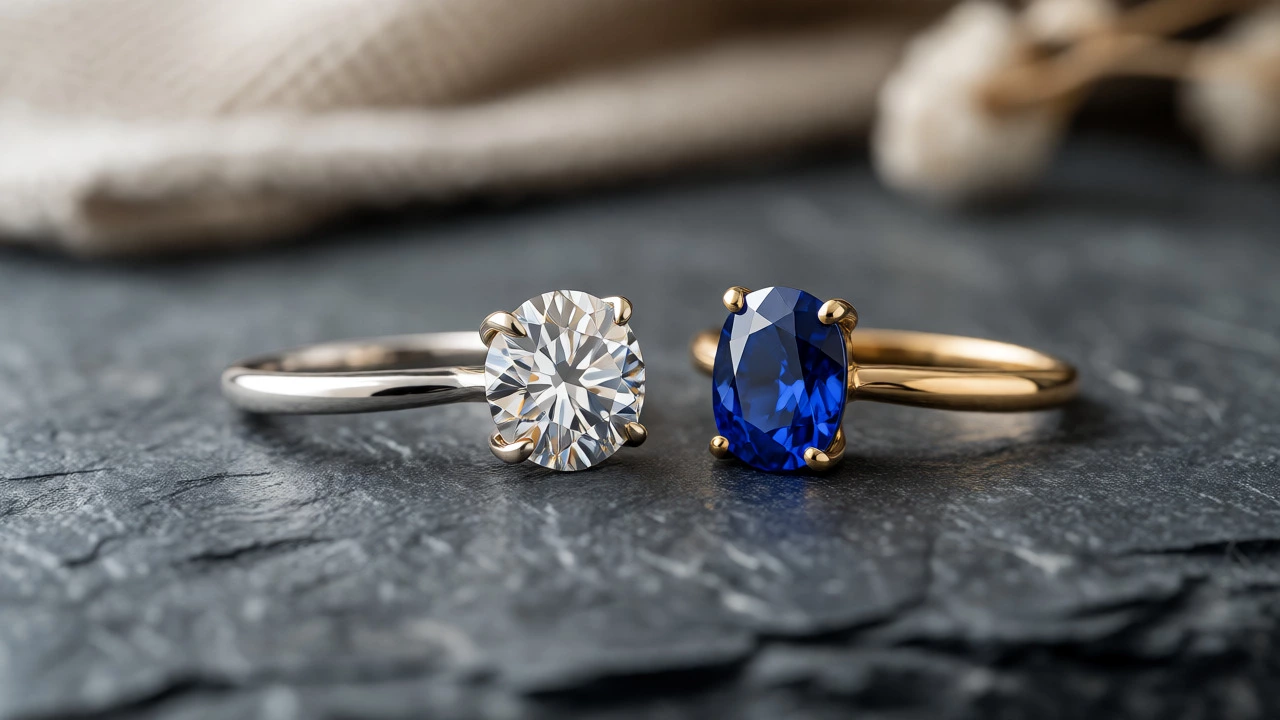
Alternatives to the Traditional Diamond
If diamonds feel overpriced or ethically questionable, there are fantastic alternatives. Lab-grown diamonds are chemically identical to mined diamonds but cost 30-40% less. They are eco-friendly and conflict-free. Another option is moissanite, which sparkles even more than diamonds but has a slight yellowish tint under certain lights.
Gemstones are also gaining traction. Sapphires, rubies, and emeralds offer color and personality. Princess Diana’s iconic sapphire ring sparked a trend that hasn’t faded. Choosing a gemstone allows for unique designs that stand out from the sea of solitaire diamonds. Plus, you can often get a larger center stone for the same price.
Vintage rings are another smart buy. Antique settings often feature intricate metalwork that modern mass-produced rings lack. Buying second-hand or estate jewelry can give you a higher-quality stone for a lower price, provided you get it appraised correctly.
Talking Money Without Killing the Romance
How do you bring up budget if you are the one proposing? Or if you are the one being proposed to? Honesty wins every time. If you are unsure, ask subtle questions. "Do you prefer big stones or detailed settings?" works better than "How much should I spend?"
If you are the proposer, remember that your partner likely values thoughtfulness over price tags. Did you listen to their hints? Did you pick a style they actually wear? Those details matter more than the receipt. If you are the recipient, and they overspent, reassure them. If they underspent relative to their means, don't judge. Discuss future financial goals together.
Consider getting insured. Regardless of the price, ensure the ring is covered under your home insurance policy. Jewelry theft claims require proof of purchase and appraisal. Keep all documentation safe.
Is the 3-month salary rule still relevant in 2026?
No, it is largely considered outdated. It originated as a marketing ploy by De Beers. Most financial advisors and wedding planners suggest spending only what fits your personal budget, regardless of salary benchmarks.
What is the average cost of an engagement ring in Ireland?
While prices vary widely, the average spent in Ireland typically ranges between €3,000 and €5,000. However, many couples opt for lab-grown options or gemstones to keep costs under €2,500.
Should I go into debt for an engagement ring?
Generally, no. Starting a marriage with high-interest consumer debt creates unnecessary stress. It is better to choose a smaller stone or alternative gemstone than to finance a luxury purchase you cannot afford.
Are lab-grown diamonds worth buying?
Yes, for many buyers. They offer significant cost savings and ethical benefits. Visually, they are indistinguishable from mined diamonds to the untrained eye. Just ensure they come with proper certification, such as from GIA or IGI.
Who traditionally pays for the engagement ring?
Traditionally, the person proposing pays. However, modern couples often split costs or contribute to a joint savings account specifically for the ring. There is no strict rule anymore; communication is key.