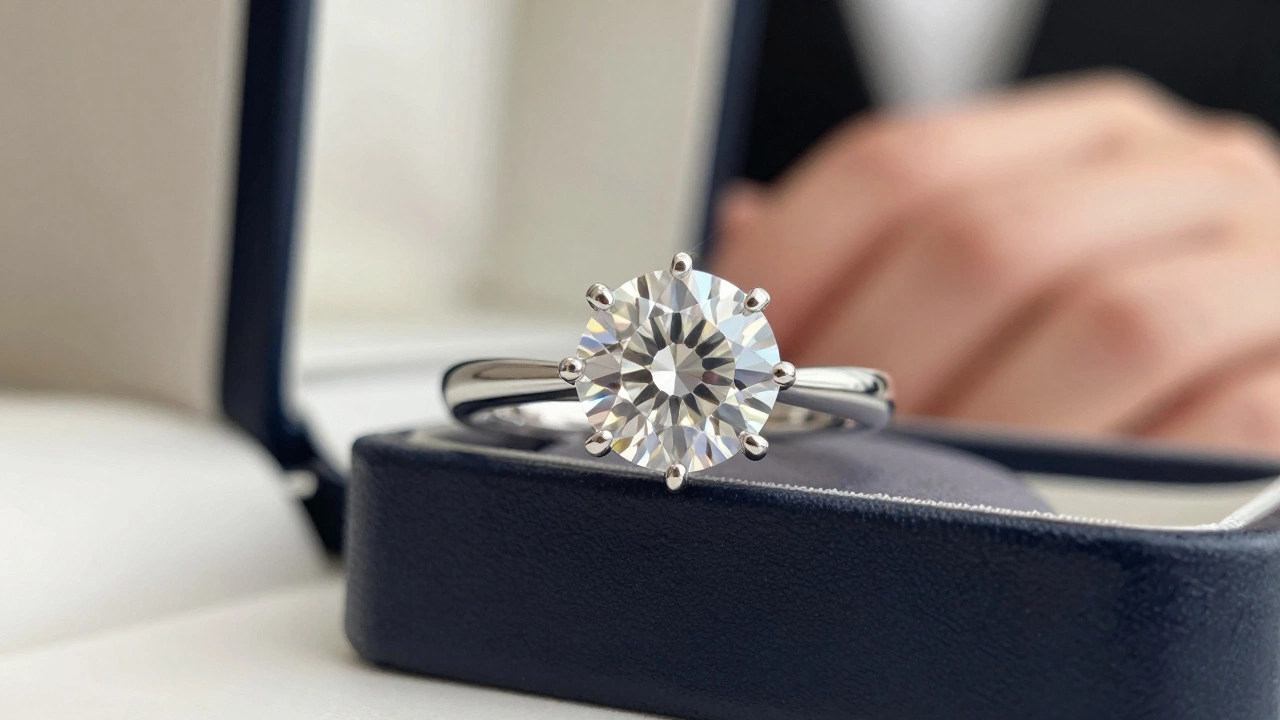
Diamond Size Calculator
Realistic Expectations for $20,000
Based on article data, you can expect:
2.5 - 3.5 carats with excellent quality
3.5+ carats will require compromises
Realistic Examples
Platinum four-prong setting, 0.30 ct side diamonds - $2,200
Platinum halo setting, 0.50 ct side diamonds - $5,500
Platinum tapered band, 0.20 ct side stones - $3,800
When you’re spending $20,000 on an engagement ring, you’re not just buying a diamond-you’re buying a symbol. But how big does that diamond actually look? And what else should you be thinking about besides carat weight? The answer isn’t as simple as a chart showing 2 carats or 3 carats. It’s about balance, cut, setting, and where you choose to spend your money.
What $20,000 Buys You in Diamonds
A $20,000 budget puts you in the upper tier of engagement ring spending. Most people spend between $5,000 and $10,000. At $20,000, you’re not just getting a diamond-you’re getting a high-quality one with room to spare on craftsmanship. But here’s the truth: carat weight alone doesn’t define beauty.
With $20,000, you can realistically get a diamond between 2.5 and 3.5 carats, depending on the other 4Cs. That’s bigger than the average engagement ring, which hovers around 1.2 carats. But if you push for 4 carats, you’ll likely have to compromise on color, clarity, or cut. And that’s where most people make mistakes.
Let’s break it down. A 3-carat diamond with G color, VS1 clarity, and an Excellent cut will cost about $18,500-$20,000. That leaves $1,500-$2,000 for the setting-platinum, hand-finished, with side stones or a halo. That’s doable. But if you want a 4-carat diamond with the same quality, you’re looking at $30,000-$40,000. So if size is your top priority, you’ll need to adjust expectations on color or clarity.
The 4Cs You Can’t Ignore
Carat is just one piece. The other three-cut, color, and clarity-determine how bright, sparkly, and clean your diamond looks. And cut? That’s the most important.
A poorly cut 3-carat diamond can look dull, lifeless, and even smaller than a well-cut 2-carat. That’s because light doesn’t reflect properly. A diamond with an Excellent or Ideal cut will bounce light back like a mirror, making it look bigger and more brilliant. That’s why many jewelers recommend prioritizing cut over carat. You’ll get more visual impact per carat.
Color matters less than you think. Diamonds graded D-F are colorless. G-I are near-colorless and look white to the naked eye, especially in white gold or platinum. A G-color diamond at $20,000 will look just as white as a D-color diamond, but cost $3,000-$5,000 less. That money can go toward a better cut or a larger stone.
Clarity is the easiest place to save. VS1 and VS2 diamonds have inclusions invisible to the naked eye. SI1 can also be eye-clean if you inspect it closely. Paying for FL or IF clarity is a waste at this price point. You won’t see the difference. Save the money.
Shape Matters More Than You Realize
Not all diamond shapes look the same at the same carat weight. Round brilliants are the most expensive because they waste the most rough diamond during cutting. If you want more size for your money, consider alternatives.
For example, a 3.5-carat oval diamond can look as big as a 4-carat round, but cost $4,000-$6,000 less. Same with emerald, cushion, and pear shapes. They’re more efficient with the rough material. A 3-carat oval might cost $14,000, leaving you $6,000 for a high-end setting.
Marquise and radiant cuts also stretch the finger and appear larger. If you’re after visual size over tradition, these shapes give you more bang for your buck. And they’re trending-more brides are choosing them now than ever before.
Setting Choices That Change Everything
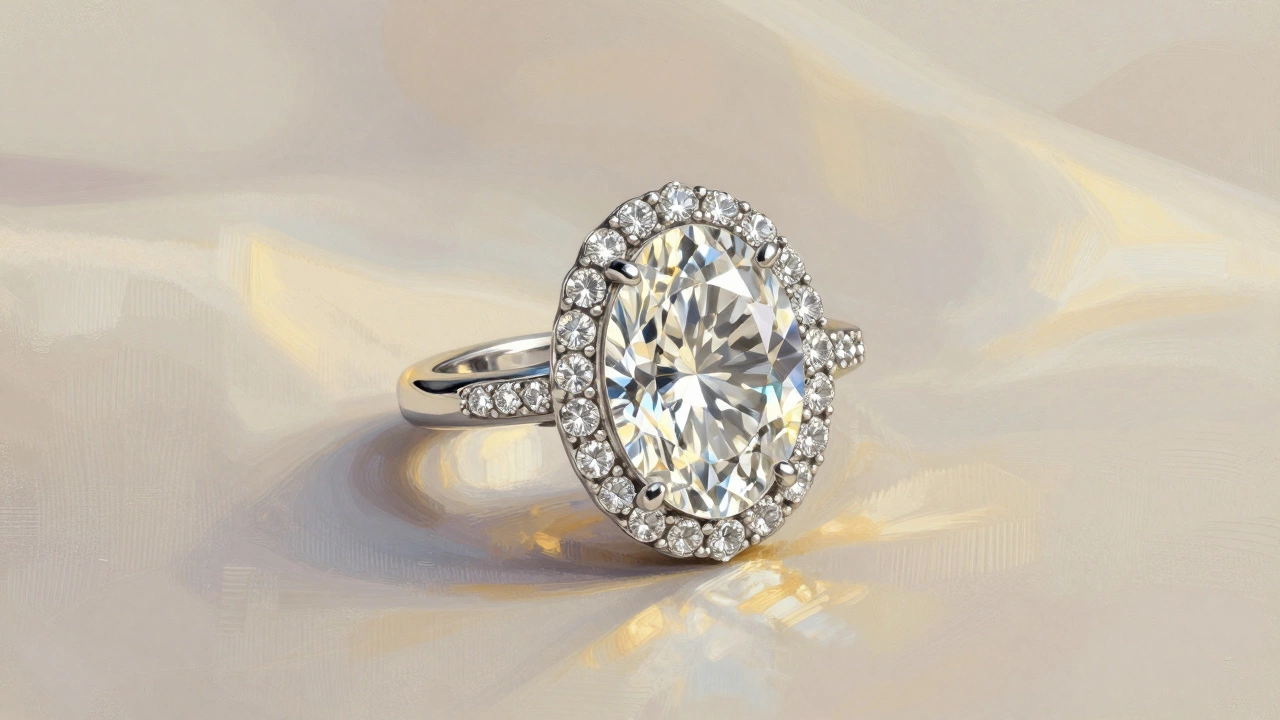
The setting doesn’t just hold the diamond-it changes how big it looks. A halo setting, for instance, surrounds the center stone with smaller diamonds, making it appear up to half a carat larger. A six-prong setting can make a diamond look more secure and prominent. A bezel setting? It makes the stone look sleek and modern, but can make it appear smaller.
Platinum is the standard for high-end rings. It’s denser and more durable than white gold, and it doesn’t yellow over time. At $20,000, you should expect platinum. A well-made platinum band with hand-engraved details or micro-pavé side stones adds luxury without costing extra on the center stone.
But here’s a tip: avoid thick, heavy bands. They can make the diamond look smaller in comparison. A slim, tapered band (2-3mm wide) draws the eye to the center stone. That’s what you want.
Where to Buy: Online vs. Brick-and-Mortar
You can buy a $20,000 ring from a luxury jeweler in New York or a boutique in LA. But you’ll pay 20-40% more for the name. The same diamond from James Allen, Blue Nile, or Brian Gavin Diamonds will be identical in quality-but cheaper.
Online retailers show 360-degree videos of every diamond. You can zoom in, rotate it, and see exactly how it sparkles. No salesperson is pushing you toward a higher markup. They’re transparent about certifications-GIA or AGS, never EGL or IGI.
Brick-and-mortar stores have their place if you want to try on rings in person. But don’t let them pressure you into buying the first diamond you see. Take photos, note the certificate numbers, and compare online prices. You’ll save thousands without sacrificing quality.
What You Shouldn’t Do
Don’t buy a diamond without a GIA or AGS report. No exceptions. Those are the only labs that grade accurately. EGL and IGI reports inflate grades-you’ll pay more for less.
Don’t chase carat weight at the cost of cut. A 3.5-carat diamond with a Fair cut will look dull. A 2.8-carat with an Excellent cut will steal the show.
Don’t skip the setting budget. A $15,000 diamond in a cheap, mass-produced setting looks cheap. That $20,000 ring deserves a custom, hand-finished band.
Don’t buy from department stores. Macy’s, Kohl’s, or Zales don’t carry diamonds at this level. Their inventory is low quality, overpriced, and rarely certified properly.
Real Examples: What $20,000 Actually Looks Like
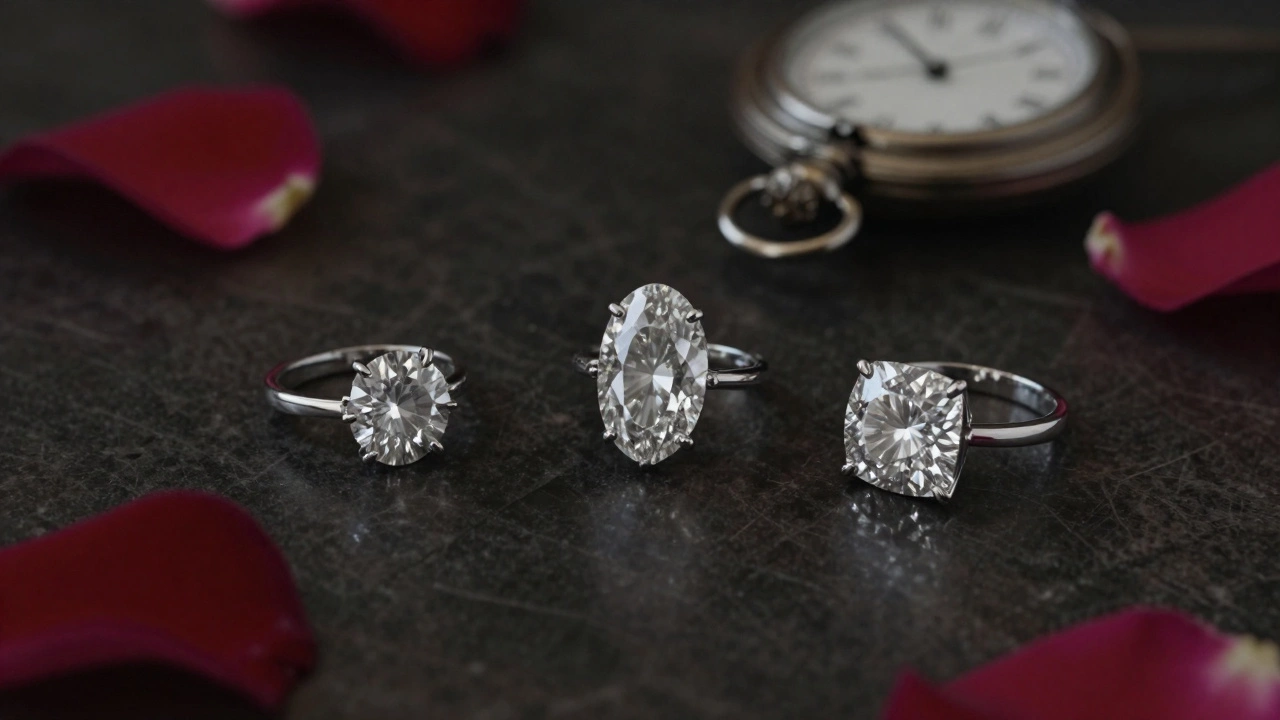
Here are three realistic setups you can get with $20,000:
- 3.0-carat round, G color, VS1 clarity, Excellent cut - $17,800. Platinum, four-prong setting, 0.30 ct total side diamonds - $2,200. Total: $20,000. This is the classic choice. Looks stunning on the hand.
- 3.5-carat oval, H color, VS2 clarity, Excellent cut - $14,500. Platinum, halo setting with 0.50 ct side diamonds - $5,500. Total: $20,000. Looks like a 4-carat stone. Very popular right now.
- 2.8-carat cushion, F color, VS1 clarity, Excellent cut - $16,200. Platinum, tapered band with 0.20 ct side stones, vintage-inspired engraving - $3,800. Total: $20,000. Unique, romantic, and timeless.
Each of these looks expensive. Each is worth the money. But only one of them screams "I spent $20,000 on a ring." The others just look like a perfect, thoughtful gift.
Final Advice: Buy for Love, Not for Show
At $20,000, you’re in the top 5% of engagement ring spenders. But the ring that lasts isn’t the biggest one-it’s the one that fits her hand, her style, and her personality. A 2.5-carat diamond with a perfect cut and a meaningful setting will be cherished more than a 4-carat stone that looks like a prop.
Take your time. Look at 10-15 options. Watch the videos. Ask for real photos in natural light. Compare prices. Don’t rush.
Because when she says yes, it won’t matter if the diamond is 2.8 carats or 3.2. It’ll matter that you chose it with care. And that’s worth more than any carat weight.